

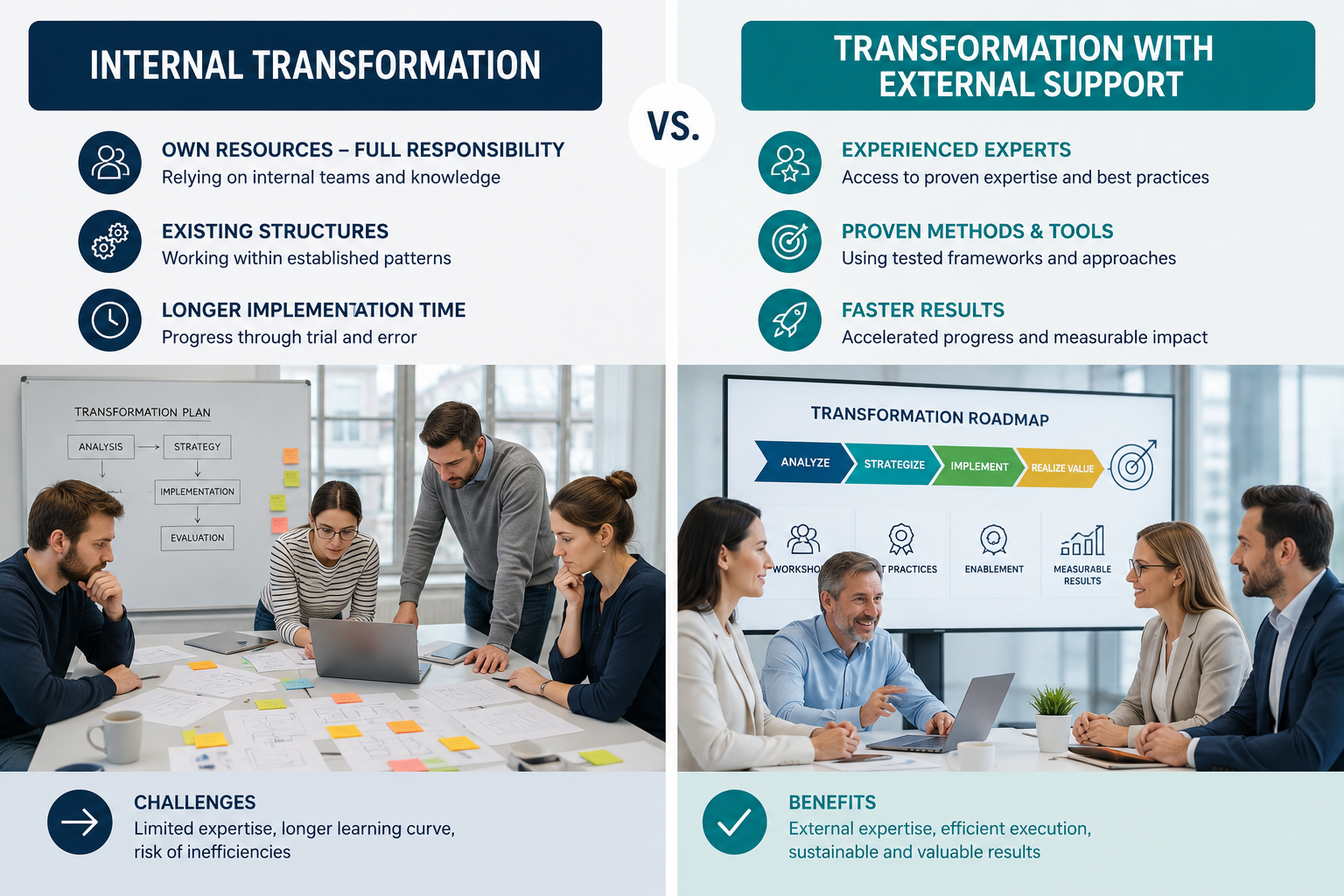
Transformation to Secure the Future: Entirely In-House or With External Support?
The pressure for change on small and medium-sized enterprises is growing steadily. Digitalization, artificial intelligence, a shortage of skilled workers, geopolitical uncertainties, and rising customer expectations are forcing companies to continuously refine their business models and processes.
The key question is no longer whether companies need to change, but how can they successfully manage this transformation.
Many CEOs and executives face a fundamental decision:
Should we implement the transformation exclusively with our own employees, or should we seek targeted external support?
In-house employees know the company, its culture, and its processes. This knowledge is valuable and crucial. At the same time, however, the top performers in day-to-day operations are already operating at their maximum capacity. As a result, transformation often becomes an additional project that must be managed concurrently with day-to-day operations.
The result: projects stall or take longer, priorities shift, and changes lose momentum.
External sparring partners or coaches bring new insights that are often lacking within one’s own organization. They draw on experience from various companies and industries, are familiar with best practices, and identify typical pitfalls early on.
Above all, they ask crucial questions that are no longer asked internally—because existing thought patterns and routines limit the view of new possibilities.
Internal Implementation or External Support?
| Criterion | Purely Internal Implementation | External Sparring Partner / Coach |
| Company Knowledge | Very high | Must be built up |
| Objectivity | Often shaped by existing structures | Neutral outside perspective |
| Best Practices | Usually limited to own experiences | Experience from external companies and projects |
| Speed | Often slowed down by day-to-day business | Focus on implementation and progress |
| Resource burden | Additional burden on key personnel | Relief for the organization |
| Impulse for change | Risk of “We’ve always done it this way” | New perspectives and fresh ideas |
| Know-how | Available, but often specialized | Broad knowledge of methods and transformation |
| Flexibility | Limited internal capacity | Support scalable as needed |
| Long-Term Personnel Costs | Creating additional positions creates long-term commitments | No long-term personnel commitments |
| Knowledge Transfer | Available internally | Targeted know-how development within the company |
The key insight: It’s not about internal versus external.
Successful transformations combine both:
This leads to better decisions, faster implementation, and a significantly reduced burden on the organization itself.
Conclusion
Transformation is an investment in the company’s future competitiveness and should not be approached as merely an added-on activity. Corporate development and transformation are central responsibilities of the leadership team and must be prioritized accordingly and driven forward consistently.
External sparring partners and coaches broaden perspectives, contribute experience from numerous transformation projects, and help avoid common pitfalls. At the same time, they take the pressure off executives and employees, ensuring that day-to-day operations are not unnecessarily compromised.
Another advantage: Companies gain exactly the expertise they need for a specific phase of the transformation without entering long-term commitments through additional permanent hires.
The question, therefore, is not whether external support is necessary, but rather where it delivers the greatest added value for the company’s success.
Whether transformation, growth, or crisis – in a personal discussion, we quickly clarify where you stand and what the next appropriate steps are.