Whether strategy, transformation, or concrete implementation
I support companies precisely where experience, structure, and clear decisions are required.
Together, we first conduct a comprehensive assessment of your company’s current status, taking into account external and internal framework conditions.
In the next step, we formulate your company’s core vision and values. Based on this foundation, we define long-term objectives and the path to achieving them. We establish milestones at meaningful intervals along the way—working backward from the goal to the starting point.
During implementation, we regularly review progress together with you and your team and verify whether the defined objectives remain valid. Should deviations occur, we adjust the course accordingly.
Throughout the entire process, I prefer working in teams. This ensures that all technical aspects are considered while keeping all participants familiar with overarching objectives and continuously informed about progress. This creates security within the team, increases motivation and loyalty, and has a positive impact on business results.
This approach in clearly structured steps is particularly effective, as deviations are identified early and corrections can be implemented with minimal effort. Otherwise, deficiencies often become visible only late, making corrections significantly more complex, time-consuming, and costly.
During my professional career spanning over 40 years, I have gained comprehensive experience through active responsibility in all relevant aspects of global business. This extends across diverse areas including technology, commercial matters, marketing, sales, procurement, manufacturing, logistics, service, team management, and organizational development. My particular strengths lie in quickly grasping complex challenges and assessing impacts across the entire value chain. With regard to sales, procurement, and partner management, I have learned to understand the needs and behavior of my counterparts and strategically incorporate them into my approach.
My motivation is to contribute and apply this experience as a sparring partner with fresh perspectives in projects. Furthermore, I am open to individual challenges and view them as opportunities for personal growth.
The constant evolution of the business environment requires companies to be willing to continuously adapt and develop. A current challenge is the need to invest in innovations. These are often presented as technological progress—associated with buzzwords such as AI, cloud, or SaaS—and promise quick solutions to complex problems. Understanding and especially keeping pace with this proves difficult for many companies or leads to overwhelm.
Ultimately, every investment must pay off in the long term. Therefore, it makes sense to view products, processes, and future direction holistically. Based on this, decisions can be made regarding the form and extent to which the deployment of new technologies is actually beneficial. Experience shows that existing processes often need to be adapted before implementation—and that in some cases, implementation should be deliberately avoided.
If these assessments are not conducted in advance, there is a risk that negative impacts on business figures or customer satisfaction will outweigh the actual benefits—thereby impairing business success.
With my experience, I support the integration of different business area requirements, their meaningful classification, and targeted coordination.
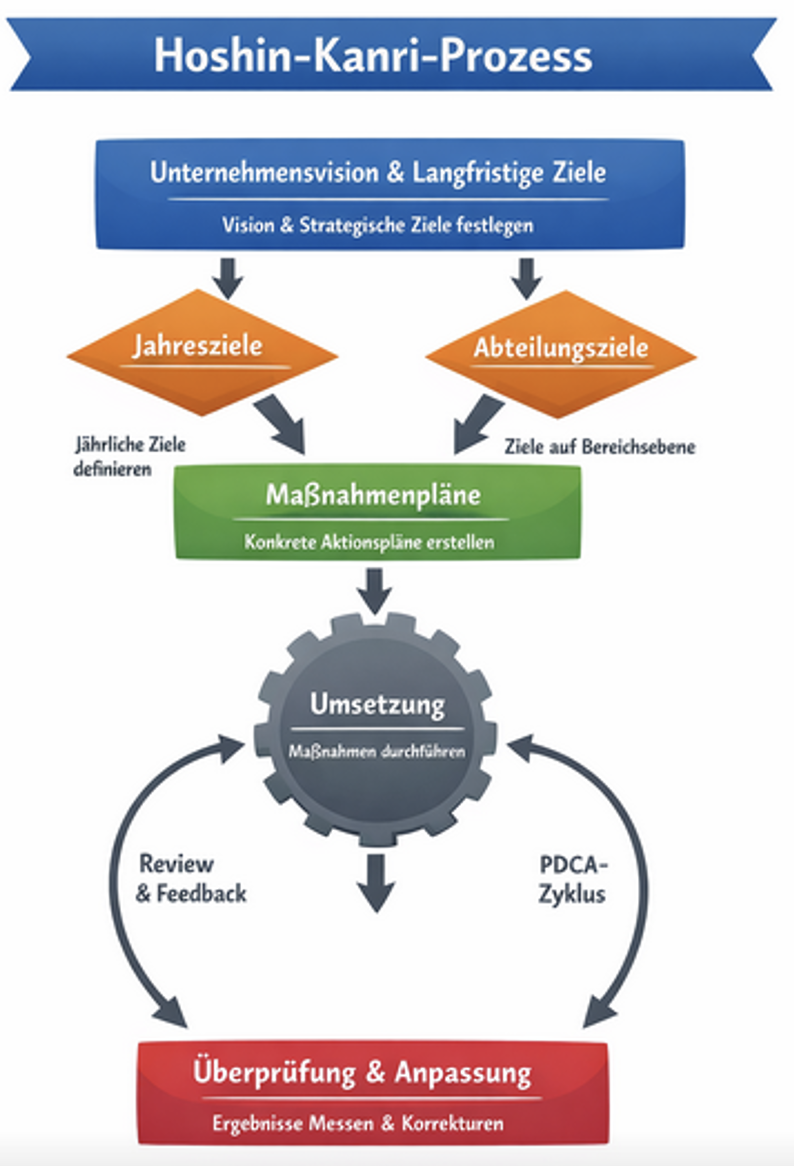
For developing and implementing corporate strategy, I follow the Hoshin Kanri process. This begins with analyzing the company’s current status. Relevant internal factors (portfolio, earnings development, organization, employee loyalty, etc.) and external factors (market, competition, target customers, suppliers and partners, etc.) are evaluated and their impact on business results assessed.
Furthermore, the long-term corporate objective (vision) is defined as clearly and comprehensively as possible. Working backward from the goal, milestones with specific content and timelines are established. Upon reaching these milestones, we verify whether intermediate objectives have been achieved and whether the final goal remains valid or should be adjusted. If necessary, corrections are made during this review.
This continuous improvement approach (Kaizen) ensures that current business parameters remain in focus at all times and necessary adjustments can be implemented early and efficiently. This prevents deviations from becoming visible only at the end, requiring corrections that are time-consuming, costly, and risky.
For developing corporate strategy, I follow the Hoshin Kanri process. This begins with analyzing the company’s current status. Relevant internal factors (portfolio, earnings development, organization, employee loyalty, etc.) and external factors (market, competition, target customers, suppliers and partners, etc.) are evaluated and their impact on business results assessed.
Furthermore, the long-term corporate objective (vision) is defined as clearly and comprehensively as possible. Working backward from the goal, milestones with specific content and timelines are established. Upon reaching these milestones, we verify whether intermediate objectives have been achieved and whether the final goal remains valid or should be adjusted. If necessary, corrections are made during this review.
This continuous improvement approach (Kaizen) ensures that current business parameters remain in focus at all times and necessary adjustments can be implemented early and efficiently. This prevents deviations from becoming visible only at the end, requiring corrections that are time-consuming, costly, and risky.
Attacks and threats to companies—both external and internal—are steadily increasing and becoming more complex and dangerous.
We evaluate your business processes and identify obvious as well as hidden risks, considering potential damages and probability of occurrence. Furthermore, we define measures to be taken in the event of damage to ensure business continuity.
The result is a structured overview in which agreed-upon steps are defined and can be applied when needed. For quality assurance, it is advisable to review this regularly and adjust as necessary.
To optimize business results, it is often beneficial to automate processes. Currently, the use of AI as a tool is particularly in focus. This technology is developing very dynamically. Therefore, before deployment, the rationale, scope, and timing of implementation should be carefully examined.
As with the introduction of any new tool, before implementing automation and AI, it must be questioned whether existing processes can be maintained or whether adjustments or redefinitions are required. In many cases, it also becomes apparent that the use of automation or AI does not always exceed the long-term economic benefit.
We support you in making informed decisions about the extent to which automation and AI can be meaningfully deployed in your company.
To optimize business results, it is often beneficial to automate processes. Currently, the use of AI as a tool is particularly in focus. This technology is developing very dynamically. Therefore, before deployment, the rationale, scope, and timing of implementation should be carefully examined.
As with the introduction of any new tool, before implementing automation and AI, it must be questioned whether existing processes can be maintained or whether adjustments or redefinitions are required. In many cases, it also becomes apparent that the use of automation or AI does not always exceed the long-term economic benefit.
We support you in making informed decisions about the extent to which automation and AI can be meaningfully deployed in your company.
The only constant is change—those who stand still fall behind. Changes therefore also require regular adjustments to organizational structure. For employees and managers, this often means leaving familiar structures and adapting to new circumstances.
However, human nature is oriented toward preserving the status quo. Changes are therefore often perceived as burdens or sources of uncertainty. This makes it all the more important to guide these processes professionally, comprehensively, and transparently across all hierarchical levels in order to maintain motivation and confidence.
We analyze metrics such as personnel development, sick leave, and turnover, monitor their trends, and develop appropriate countermeasures when needed.
Plans need to be implemented. I accompany and support you in implementing your initiatives—with a clear focus on quality and sustainability, from planning through design to implementation and acceptance. In doing so, I follow the principle: "Do the right thing, the right time, the first time".

Attacks and threats to companies—both external and internal—are steadily increasing and becoming more complex and dangerous.
We evaluate your business processes and identify obvious as well as hidden risks, considering potential damages and probability of occurrence. Furthermore, we define measures to be taken in the event of damage to ensure business continuity.
The result is a structured overview in which agreed-upon steps are defined and can be applied when needed. For quality assurance, it is advisable to review this regularly and adjust as necessary.
Whether transformation, growth, or crisis – in a personal discussion, we quickly clarify where you stand and what the next appropriate steps are.